What makes a Maine Coon color rare?
“Rare” gets used loosely for Maine Coon colors, and it can mean three different things.
- Genetic rarity: how uncommon the combination of genes behind a coat is. Some coats need several specific genes at once, or an unusual chromosome makeup.
- Population rarity: how often a coat actually appears among Maine Coons. We have not found any registry that publishes counts of Maine Coons by color, so treat any claim that a color is “1 in 100” or “the rarest” with caution.
- Selective breeding complexity: how much knowledge and how many generations of selection it takes to produce a refined version of a coat consistently.
These overlap, but they are not interchangeable. A male tortoiseshell is rare in the genetic sense: it takes an unusual chromosome makeup or cell mixture. A refined silver shaded or shell Maine Coon is best described by the third sense. How often such cats occur has not been measured, and genetic complexity on its own does not tell us how common a coat is.

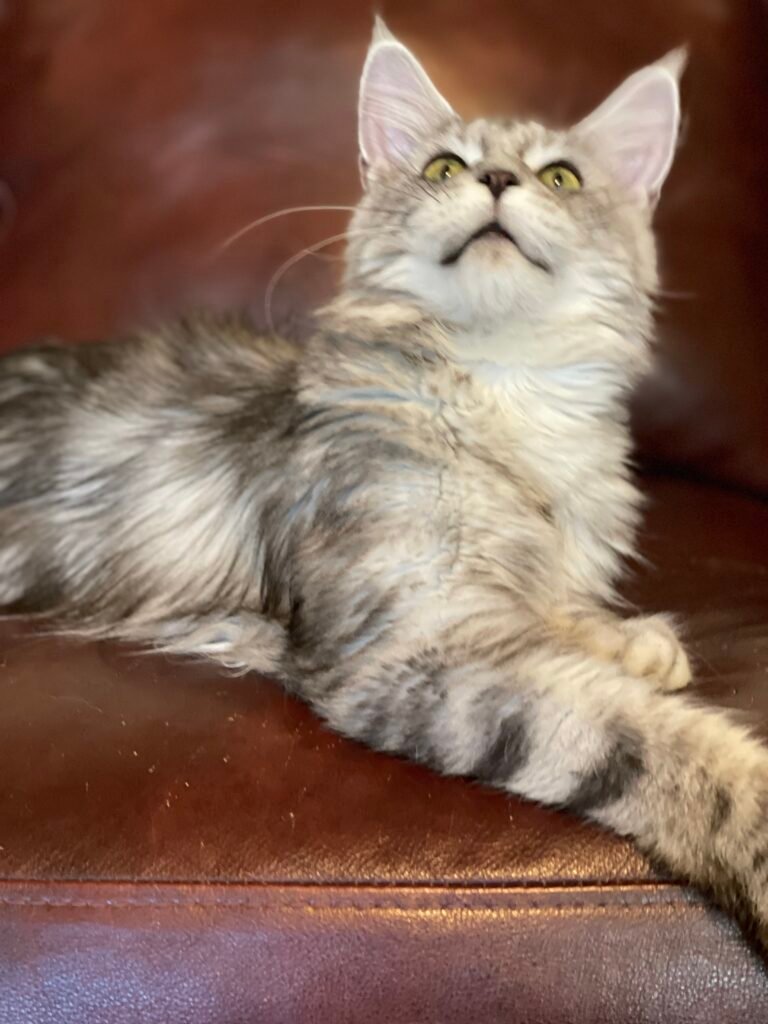
Valentina, a silver shell Maine Coon female from our breeding program.
Valentina is a silver shell, the coat the CFA standard calls chinchilla silver. Shell is the lightest of the silver coats: color is limited to the very tip of each hair, and the rest of the hair is white. On Valentina, that tipping is so fine it is hard to see, and her coat reads as almost pure white with a silver sheen.
Generations of selective breeding behind silver shaded and shell Maine Coons
The refined silver shaded and shell coats admired today are the result of generations of deliberate selective breeding. While the silver inhibitor is inherited as a dominant trait, the gene alone does not determine whether a cat will have the delicate tipping, exceptionally pale undercoat, or minimal visible tabby markings characteristic of these coats.
Breeders have worked across generations to refine these characteristics, selecting cats not only for their individual appearance but also for their ability to reproduce those qualities in future generations.
What the inhibitor gene does, and what it doesn’t
Inheritance: the silver gene, called the inhibitor (I), is dominant: “only one copy is needed to express silver,” according to the University of Missouri Feline Genetics Laboratory, which offers the test for it. It suppresses pheomelanin, the yellow-red pigment, so the parts of the hair that would carry it are left white. The lab notes that the exact gene has not yet been identified.
Band width and appearance: the same lab states that the inhibitor “does not control the width of the band” of pale hair. Whether a silver cat looks smoke, shaded or chinchilla (shell) depends on whether it is a tabby underneath and on how wide that pale band is. The band width, the fineness of the tipping and how much tabby pattern shows are controlled by other genetic modifiers. CFA’s genetics guide models this factor as a “wide band” gene, Wb (CFA, Colors, Patterns and Genetics). Variants that widen the pale band have been found in the CORIN gene, but in golden coats of other breeds (OMIA). None has been confirmed as the cause of shaded or shell tipping in silver Maine Coons, and no DNA test predicts it. Breeders select for them by observing their cats, generation after generation.
What we select for
In our breeding program, we look at:
- How much pigment each hair carries, and where along the hair it sits
- Delicate, even tipping across the body
- A clean, pale undercoat with no warm or brownish tones
- As few visible tabby markings as possible
- Whether those qualities carry through to the next generation, not just one cat
A long tradition of selection
The CFA Foundation’s history project describes the first clear-coated silvers at British shows in the 1880s as silver tabbies with “very few stripes.” Breeders kept selecting the most lightly marked cats, and Silver Lambkin, born in 1889, became the main foundation sire of the chinchilla. That record is about Persian-type longhairs, not Maine Coons. It does not tell us how shaded and shell lines developed within the Maine Coon breed. What it does show is that the clear silver coat has been pursued through deliberate selection since the earliest cat shows.
This is an important distinction. Traditional solid and tabby coats have their own genetic foundations and breeding objectives, but developing a consistently refined silver shaded or shell coat involves additional selection for the distribution of pigment, clarity of the coat, and expression of its pattern.
At Bellspurr, we value these coats as the result of genetic knowledge, careful breeding decisions, and the work of generations of dedicated breeders.
The colors in our breeding program

The uncommon colors we focus on at Bellspurr are silver shaded and high smoke, all in the black color line. Our lines lean toward shaded and high smoke, so our cats are paler than silvers from lines that aren’t selected for shading. Our breeding program does not work with red variations, because we focus on the black color line.
In silvers, a few points help tell a pale silver from a white cat. The CFA Maine Coon standard calls for the rims of the eyes, lips and nose to be outlined in black on chinchilla and shaded silvers, with brick-red nose leather and black paw pads. A white cat has none of that black outlining.
Smoke, shaded and shell: how to tell them apart
Our favorite coat is the shaded or chinchilla (shell). All three of these coats carry the silver gene. What separates them is whether the cat is a tabby underneath and how much of each hair stays white. CFA’s guide to determining a cat’s color gives a rule of thumb: about one-eighth of the hair length is colored at the tip in chinchilla and shell, about a quarter in shaded, and about half in smoke (CFA, Hints for Determining a Cat’s Color). The descriptions below come from the CFA standard. Other registries, including TICA, write their own color descriptions, and their wording and color classes are not identical.
- Smoke is the silver gene on a solid (non-agouti) cat. CFA describes a black smoke as a “white undercoat, deeply tipped with black” that “appears black” at rest, with a narrow white band at the base of the hairs, and black nose leather and paw pads. “High smoke” is a term breeders use for a smoke with a longer white band. It is not a separate color class in the CFA standard.

- Shaded is the silver gene on a tabby (agouti) cat with a medium pale band. CFA describes a shaded silver as a white undercoat “with a mantle of black tipping shading down from sides, face, and tail.”
- Shell (chinchilla) has the widest pale band. CFA describes a chinchilla silver as a pure white undercoat, “sufficiently tipped with black to give the characteristic sparkling silver appearance.”
A cat cannot be shaded and smoke at the same time, because a cat is genetically either agouti (tabby) or non-agouti (solid). For photos of all three side by side, see Differences between silver, shaded and smoke Maine Coons. The genetics are covered in Understanding the silver gene.
Cream smoke and blue smoke Maine Coons
Cream and blue are the diluted forms of red and black. The dilute gene spreads pigment unevenly along the hair shaft and lightens every color (UC Davis Veterinary Genetics Laboratory). Cream is diluted red, a pale off-white or beige. Blue is diluted black, which looks gray.
A cream smoke is the silver gene on a solid cream cat. CFA describes a cream smoke as a white undercoat “deeply tipped with cream”: the cat looks cream at rest, and the white shows when the coat parts or the cat moves. For cream smokes, CFA lists pink nose leather, eye rims and paw pads as desirable. A blue smoke is the same pattern on a blue cat, with blue nose leather and paw pads. Both need two copies of the recessive dilute gene plus at least one copy of the dominant silver gene.
Cream is a red-based color, so it follows the orange gene on the X chromosome. A male needs one copy to be cream. A female needs it on both X chromosomes.
What colors can Maine Coon cats be?
Every Maine Coon color comes from two pigments: black (eumelanin) and red (pheomelanin). In everyday speech, a red cat is called orange and a blue cat gray. In cat genetics, the terms are red and blue.
- Black and blue: black pigment comes from the B locus, where black is dominant over chocolate and cinnamon. Blue is diluted black (UC Davis VGL).
- Solid or tabby: a separate gene, agouti, decides whether tabby markings show. Cats with two copies of non-agouti (aa) are solid (UC Davis VGL). The CFA standard recognizes classic, mackerel and ticked tabby patterns.
- Red and cream: red is carried on the X chromosome. In 2025, two research groups, including one at Stanford Medicine, traced it to a small deletion that switches on a gene called ARHGAP36 in pigment cells (ScienceDaily). Cream is diluted red.
- White: dominant white masks the cat’s real color. It is caused by a variant in the KIT gene (David et al. 2014). White Maine Coons are not albino, because albinism comes from a different gene, the color (C) locus (UC Davis VGL). The CFA standard allows green, gold, green-gold or copper eyes in Maine Coons, and blue or odd eyes in white cats and cats with white. More in The white Maine Coon cat.
- Colors not accepted: the CFA standard disqualifies Maine Coons showing chocolate, lavender, or the Himalayan (pointed) pattern resulting from hybridization. TICA’s standard sets its own rules. A coat advertised as “rare” may simply be one that a breed standard doesn’t allow.
For every color and pattern described in detail, see Exploring the colors and patterns of Maine Coons. For photos of real cats in each color, see Maine Coon colors with pictures. Red Maine Coons have their own article: The fascinating world of orange Maine Coon cats.
Male tortoiseshell and calico Maine Coons
A tortoiseshell (tortie) Maine Coon has patches of black and red, or their dilutes blue and cream. A calico is a tortie with white. Tortoiseshell normally occurs in females: with two X chromosomes, one carrying orange and one not, different patches of skin express different colors.
A male usually has one X chromosome, so he carries only one version of the orange gene. A tortoiseshell male needs cells carrying both versions, which can happen in more than one way:
- XXY: an extra X chromosome. This was confirmed in a male tortoiseshell cat in 1981 (Hageltorn and Gustavsson, Journal of Heredity).
- XX/XY chimerism: the male’s body contains two cell lines, one XX and one XY. A 2026 report described a Maine Coon tortoiseshell tomcat with XX/XY chimerism who sired a litter of five healthy kittens (Sexual Development, 2026).
- Mosaicism: a 1984 study described two fertile male tortoiseshell Burmese with normal XY chromosomes, explained by instability at the orange gene. In the same study, a third tortie male with XXY chromosomes was sterile (Journal of Heredity, 1984).
Because fertility varies with the cause, the authors of the 2026 report recommend chromosome testing of tri-colored males before deciding whether to use them for breeding. A calico male at a Texas cat show even caused a controversy (D Magazine).
Understanding silver and blue Maine Coon genetics
When the silver gene is combined with two copies of the dilute gene (d), black pigment becomes a soft blue-gray, giving a blue silver Maine Coon.
Blue silver tabby
Blue-gray tabby markings on a pale silver ground.
Blue smoke tortoiseshell
Patches of blue and cream over a white undercoat. This coat needs the silver gene, two copies of dilute, a solid (non-agouti) base, and two X chromosomes carrying different versions of the orange gene. That is a genetically complex combination. Complexity is not the same as measured prevalence, though: we have not found any published figure for how often this coat occurs.
This table summarizes the main genes behind the coats in this article.
| Trait | Gene (locus) | What it controls | Inheritance | Source |
|---|---|---|---|---|
| Black pigment | Brown (B) | Black (B) versus chocolate (b) and cinnamon (bl) | Autosomal; black dominant over chocolate and cinnamon | UC Davis VGL |
| Solid or tabby | Agouti (A/a) | Whether tabby markings show; aa cats are solid | Autosomal; agouti dominant | UC Davis VGL |
| Blue / cream | Dilute (D/d) | Lightens black to blue and red to cream | Autosomal recessive (two copies needed) | UC Davis VGL |
| Silver | Inhibitor (I) | Suppresses pheomelanin; band width set by other modifiers | Autosomal dominant; gene not yet identified | Univ. of Missouri |
| Red / cream | Orange (O) | Red pigment in place of black | X-linked (ARHGAP36 region) | ScienceDaily |
| White | Dominant white (W), KIT gene | Masks all other color | Autosomal dominant | David et al. 2014 |
Quick answers about rare Maine Coon colors
Are blue smoke Maine Coons rare? Genetically, a blue smoke needs the silver gene, two copies of dilute, and a solid base all at once. We have not found published counts of how many exist.
Are light colored black smoke Maine Coons rare? A very light black smoke, which breeders often call a high smoke (a breeders’ term, not a registry color class), comes from selecting for a wider pale band at the base of the hair. As with shaded and shell, that comes from selection over generations, not from the silver gene alone.
How rare are white Maine Coon cats? We have not found published counts. Dominant white needs only one copy of the gene. See The white Maine Coon cat.
Is there such a thing as a gray Maine Coon cat? Yes. In cat genetics a gray cat is called blue, which is diluted black.
Can a Maine Coon be black? Yes. A solid black Maine Coon has black pigment and two copies of non-agouti, so no tabby pattern shows.
Can a black and white cat be a Maine Coon? Yes. Black and white is listed in the bi-color class of the CFA Maine Coon standard.
Rare, and which kind of rare
A Maine Coon’s color doesn’t change its personality or how you care for it. When a coat is called rare, the useful question is which kind of rare it is: a chromosome exception like a male tortie, an uncommon combination of genes like a blue smoke tortie, or a coat like a refined shell that took generations of deliberate selection to develop.
See our available Maine Coon kittens on the Maine Coon kittens for sale page. If you want to apply for a Bellspurr Maine Coon kitten, fill out the application.
