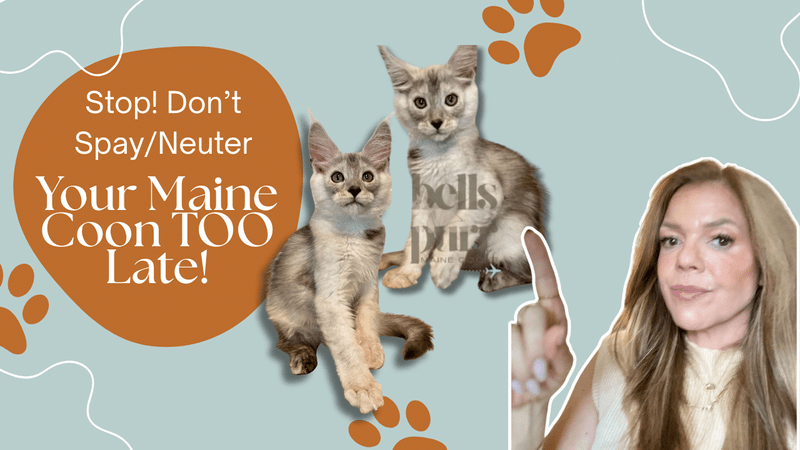
Wondering when to spay and neuter your Maine Coon kittens? Expert insights and real breeder opinions to help you decide when to spay/neuter your Maine Coon.
Timing matters more than most new owners realize. Wait too long and you’re dealing with spraying, heat cycles, and real health risks. Here’s what you need to know.
When to spay and neuter a Maine Coon kitten: timing, health, and why it matters
1. At what age should you spay or neuter a Maine Coon?
What age to spay a Maine Coon varies. Feline veterinary groups now recommend having cats altered by around 5 months of age, and earlier is perfectly safe. The guideline we go by is simple: 6 months of age or 6 pounds, whichever comes first. Most vets are comfortable with that timing, so you won’t have to argue for it.
This timing works well. It’s early enough to stop accidental breeding and hormone-driven behavior before it starts. The kitten is also mature enough for surgery at this stage.
Don’t wait past it. A male neutered by 6 months usually never starts spraying. A female spayed on time never goes through heat cycles, never starts spraying (yes, intact females spray too), and never faces the risk of pyometra.
2. Why cats are different from dogs
If you’ve had a dog, you may have heard that you should wait until they’re older to spay or neuter. That advice is real, but it’s about dogs, not cats.
In dogs, especially large breeds, a large UC Davis study of 35 breeds linked early spay/neuter to a higher rate of joint problems like hip dysplasia and cruciate ligament tears, and in some breeds to certain cancers. Sex hormones play a part in closing the growth plates in a dog’s long bones, so removing them early can let the bones grow longer than they should and change how the joints line up. That’s why many vets now recommend waiting until a large-breed dog is closer to full grown.
Cats don’t show the same pattern. Research on kittens spayed or neutered early, including long-term follow-up studies, hasn’t found the increase in orthopedic disease or the other problems seen in dogs. Early-altered cats grow to normal size, and the main behavioral differences are the ones you want: less spraying, less roaming, less fighting. That’s why the AVMA, AAFP, and AAHA all back the “Fix by Five” recommendation to spay and neuter cats by 5 months of age, and why shelters routinely alter kittens at 8 weeks.
So the “wait until they’re older” rule is a dog rule. For a Maine Coon, waiting only opens the door to heat cycles, spraying, and accidental litters.
3. Health benefits of timely spay/neuter
Most vets today agree that fixing kittens at the right time is safe and doesn’t affect your Maine Coon kitten at all. It helps prevent health problems and doesn’t slow down their growth. When a vet who works with cats every day performs the surgery, kittens recover quickly and do great afterward.
Benefits include:
- Lower risk of reproductive cancers
- Reduced hormone-driven behaviors (marking, aggression, escape attempts)
4. What happens if you wait too long
Unneutered males often spray and mark inside the home. No typical family wants to live with that, which can lead to behavioral issues, rehoming, or even abandonment. A neutered Maine Coon male will usually stop — or never start — spraying if neutered by 6 months old.
If a female Maine Coon is not spayed, she will go into heat every two weeks. This cycle continues until she is either bred or spayed. And it’s not only males: an intact female can spray and mark too, especially when she’s in heat. These constant hormone changes can lead to stress and behavior problems. Over time, they raise her risk for pyometra. This is a serious and sometimes deadly infection of the uterus. Spayed Maine Coon kittens never have to deal with any of this. They avoid the stress, heat cycles, and risks completely.
5. Why responsible breeders require it
Bellspurr invests in:
Full genetic testing
Years of pedigree tracking, among many other things
If we allow kittens to go to homes without fixing them, someone could breed them — without any health checks or understanding of the breed.
The person might not do any health testing (for Hip Dysplasia) or know how to raise Maine Coons properly. That can lead to unhealthy litters and serious problems for the kittens. It also puts the future of the breed at risk.
A spay/neuter agreement makes sure every pet kitten is altered on time. That keeps them healthy, protects our lines, and helps make sure people breed responsibly.
We don’t sell breeding rights. Every Bellspurr kitten is placed as a pet, and that’s not something we make exceptions for. Breeding is complex, serious, and easy to get wrong, and it’s not something we want to encourage casually.
Some new buyers get a female first and then look for a male later. This causes more problems, especially with open catteries. These catteries let outside studs breed, which spreads venereal diseases.
Bellspurr is a closed cattery.
We protect our males, our bloodlines, our reputation, and the health of our entire program — including your future kitten.
Sharing our pedigrees is a big deal, and we don’t take it lightly.
Some people try to save money by breeding and giving kittens to family or friends, but that’s not fair. We spent years earning the trust of top breeders and traveling to Europe to bring these cats into our program. Protecting our lines is a serious responsibility — not something we hand out casually.
We’ve made a huge investment building this program. When we price a kitten, it doesn’t reflect the full value of a breeding cat.
Some kittens carry traits that don’t matter for pets but could cause harmful health conditions if paired with another carrier. If someone breeds without testing, they could end up producing sick litters.
That’s why we’re extremely careful about who gets access to our lines. A spay/neuter agreement is how we protect Maine Coons and make sure breeding stays responsible.
6. How it works at Bellspurr: the SpaySecure agreement
Bellspurr Maine Coon kittens go home at 11 weeks with a SpaySecure spay/neuter agreement. Your kitten goes home intact, and you have them altered by your own trusted vet by 6 months of age or 6 pounds, whichever comes first.
SpaySecure is a third-party service built for exactly this. It manages the spay/neuter agreement for both of us, so neither of us has to keep track of paperwork or deadlines by hand. Here’s what it looks like from your side:
- The agreement. As part of your kitten’s paperwork, you’ll sign a SpaySecure Sterilization Agreement. It’s a simple, binding promise to have your kitten spayed or neutered by the deadline and to send proof to SpaySecure. If you’d like to read it before committing to a kitten, ask me and I’ll send you the one-page contract summary.
- Reminders. As the deadline approaches, SpaySecure reminds you by email, text, phone, and even mail, so it doesn’t slip through the cracks during a busy season.
- Help along the way. If you need a clinic, SpaySecure can help you find one near you. If something comes up and you need more time, you request an extension through them.
- Proof of surgery. Once it’s done, your vet fills out a short attestation form (or you send the vet records) and you upload it to SpaySecure. That’s it. Done.
What if the deadline is missed? SpaySecure steps up the reminders and works with you to get it finished. Buyers who ignore the agreement entirely can face late fees and be listed in SpaySecure’s noncompliance database, which is shared with other member breeders. In practice, it rarely gets that far with the families we place kittens with; the reminders do their job.
Getting it done on time means you won’t have to handle heat cycles, spraying, or other hormone-driven behaviors while your kitten settles in. It also means no risk of unexpected litters. Instead of worrying about what could happen, you can focus on loving your new baby. You can bond, play, and build a strong relationship from day one.
FAQ: spay and neuter at Bellspurr
1. Do Bellspurr kittens go home spayed or neutered?
No. Kittens go home at 11 weeks with a SpaySecure spay/neuter agreement. You have your kitten altered by your own vet by 6 months of age or 6 pounds, whichever comes first.
2. What is SpaySecure?
SpaySecure is the service that manages our spay/neuter agreement. It sends you reminders before the deadline and lets you upload proof of surgery once it’s done, so the paperwork is handled for both of us.
3. Is spay/neuter at 6 months safe for Maine Coons?
Yes. It’s safe, kittens recover quickly, and it doesn’t affect their growth. Use a vet you trust who is comfortable working with cats.
4. Do fixed males still spray?
No. If neutered before 6 months old, most males never start spraying. This helps avoid behavioral problems and keeps your home clean.
5. What happens if a female Maine Coon isn’t spayed?
She’ll go into heat about every two weeks until bred or spayed. This causes stress and increases the risk of a deadly infection called pyometra.
6. Do you ever sell breeding rights?
No. We don’t sell breeding rights. Every Bellspurr kitten is placed as a pet only, with a SpaySecure spay/neuter agreement.
Find your kitten here Maine Coon Kittens For Sale